


PECES LOROS
PARROTFISHES
PARROTFISHES
| Photos and text by David Nuñez |
| Existen más de 80 especies de pez loro en los arrecifes del mundo. Deben su nombre a su boca de dientes fusionados que asemeja un pico de loro. En el Caribe Mexicano tenemos más de una docena de especies, aunque mencionamos tan solo aquellas mas fáciles de identificar. Ya sea comiendo, reproduciéndose o durmiendo, los peces loros nos ofrecen algunas de las excentricidades más memorables del arrecife. Son mayoritariamente herbívoros que se alimentan de algas que crecen sobre coral muerto, aunque algunas especies se alimentan del coral mismo. En ambos casos es posible escuchar el crujir de los peces loros mordiendo el coral mucho antes de verles. Tienen una segunda “boca” en la garganta con la que muelen el coral, que a su vez es excretado como arena. Debemos agradecerles, pues su sistema digestivo es responsable, por lo menos parcialmente, por las finas arenas blancas que tanto disfrutamos. Al forrajear pueden formar agrupaciones defensivas. Ya que se alimentan de algas que de lo contrario cubrirían al arrecife, los peces loro son muy importantes para la salud general del arrecife. Su desarrollo social-sexual puede ser complicado. Al igual que con los meros, los machos tienen un harén de hembras, de las cuales una se convierte en macho al morir el macho previo. Sin embargo también hay algunos que nacen ya machos. Las hembras y jóvenes comparten la misma coloración deslucída, y adquieren colores más vivos únicamente al convertirse en machos adultos. Esto permite a los machos jóvenes infiltrarse en el harén, haciéndose pasar por hembras, para aparearse furtivamente. Finalmente, todos estos detalles reproductivos varían no solo entre una especie y otra, sino dentro de una misma especie según su ubicación geográfica. Ya que los depredadores nocturnos se guían por el olfato, los peces loro han desarrollado una estrategia singular para disuadirlos: construyen una burbuja mucosa apestosa (y de mal sabor) dentro de la cual duermen. Estos capullos están abiertos a ambos extremos para permitir el flujo de agua, y su construcción tarda aproximadamente unos 30 minutos. Viven entre 5 y 20 años, y pueden llegar a medir entre 30 cm y 1.2 m, según la especie. |
| There are over 80 species of parrotfish living in coral reefs around the world. Often fancifully colored, they get their name from their beak- like mouth, which is made up of fused teeth. In the Mexican Caribbean there are over a dozen species, though we will mention just a few of those easier to identify. Whether feeding, mating or sleeping, parrotfish offer us some of the more bizarre and memorable behavioral eccentricities among reef dwellers. They are primarily herbivores that feed on algae which grows on dead coral, though some species may feed on the coral itself. In either case one can often hear the crunch of parrotfish biting down on coral long before one sees the parrotfish. They have a second set of jaws in their throat to grind down the coral, which is excreted as sand. Thus we can thank the parrotfishes, for their digestive tracts are at least partially responsible for the white sandy beaches we enjoy so much. They often feed in groups. Because they feed on algae that would otherwise smother the reef, parrotfish are important for the overall health of the reef. Parrotfish social-sexual development can be complicated. As with grouper, males have a harem of females, and upon the death of the male a female will take its place. However, some individuals are also born males. Females & juveniles are drab colored and only take on vivid tones as they become adult males. This allows younger males to infiltrate the harem by impersonating a female and thus mate with the real females by stealth. Finally, the details of these reproductive habits may vary not only from one species to the next, but even within species according to geographical location. Because night-predators are guided by scent, parrotfish have developed a unique strategy to discourage enemies: they build a foul-smelling (and tasting) mucous bubble in which to sleep. These cocoons are open at both ends to allow water flow, and take about 30 minutes to construct. Their lifespans range from 5 to 20 years depending on the species, and lengths can vary from 30 cm to 1.2 m. |
| Loro Guacamayo Rainbow Parrotfish Scarus guacamaia |
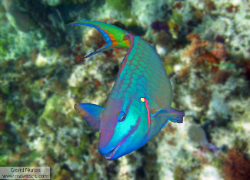
| Loro Viejo Stoplight Parrotfish Sparisoma viride |
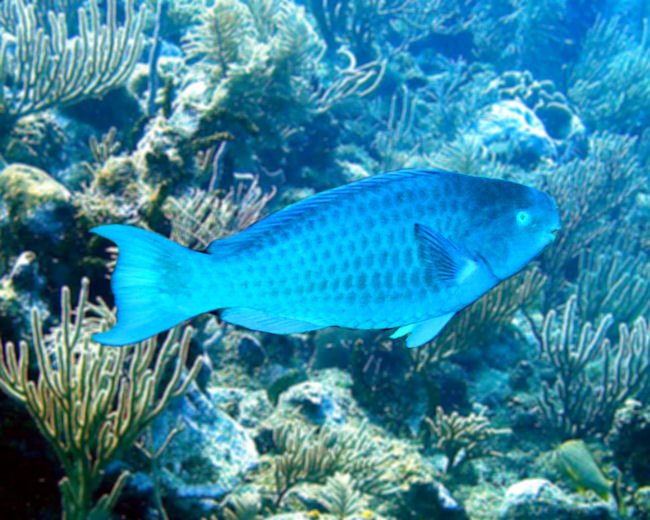
| Loro Azul Blue Parrotfish Scarus coeruleus |
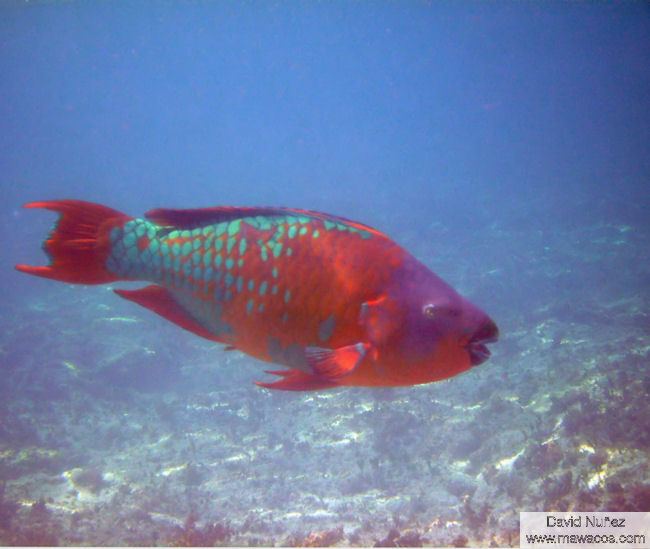

| El Pez Loro Guacamayo es una especie CASI AMENAZADA. |
| The Rainbow Parrotfish is NEARLY THREATENED. |


| Recomendamos estos libros sobre la Fauna de México. (Los nuestros son bilingues.) |
| To learn more about the Wildlife of Mexico, we recommend the following books. |
|


